
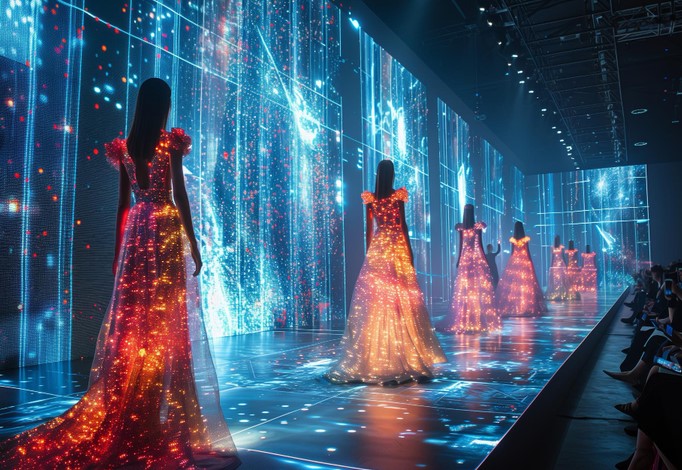
 Imagine standing in the front row of a high-fashion runway show in Paris. Models glide past you wearing garments made of shimmering liquid chrome and floating starlight—materials that physically cannot exist in the real world. You aren’t squeezed into an overcrowded venue or fighting for a view behind a celebrity’s hat. You are sitting in your living room, wearing a lightweight headset, experiencing full spatial audio and 360-degree immersion.
Over my past decade evaluating spatial computing, wearable sensors, and emerging tech stacks, I’ve watched industries resist digital transformation until a tipping point forces their hand.
I remember testing early virtual runway prototypes where digital fabrics looked like stiff cardboard and avatars walked like robotic block figures. It felt gimmicky. But over the last few years, the leap in real-time ray tracing, volumetric capture, and cloth physics engine integration has flipped the script completely.
Today, VR fashion shows are no longer a novelty backup plan—they are rapidly becoming the primary launchpad for global couture and digital fashion ecosystems.
Beyond the Velvet Rope: Why Fashion Is Moving to Spatial Computing
Traditional physical fashion weeks are notorious for extreme costs, massive carbon footprints, and rigid exclusivity. A single 15-minute runway event can cost luxury houses anywhere from $100,000 to over $1 million, while generating tons of waste from temporary set builds and international travel.
+-------------------------------------------------------------+
|                PHYSICAL VS. VR FASHION SHOWS                |
+-------------------------------------------------------------+
| Physical Runways   --> Geographically Locked & High Carbon  |
| VR Fashion Shows   --> Infinite Scale & Zero Physical Waste  |
| Combined Ecosystem --> Direct-to-Avatar & Phygital Retail   |
+-------------------------------------------------------------+
Virtual reality smashes these physical constraints. It democratizes the front-row experience for global audiences while unlocking artistic freedom that physical physics simply won’t allow.
Modern vr fashion shows bridge three major spaces:
-
Digital-Only Haute Couture: High-concept garments designed purely for virtual avatars and digital identity.
-
“Phygital” Runways: Virtual events where attendees can preview 3D garments and instantly order physical versions tied to digital twin NFTs or NFC authenticity chips.
-
Immersive E-Commerce: Converting a passive runway viewer into an active buyer who can inspect stitching down to the millimeter in 3D space.
The Tech Behind the Virtual Runway: How Digital Fabrics Come Alive
To understand why modern virtual runways feel so breathtakingly real, we have to peek under the hood at the software engines driving them.
1. Volumetric Capture and Photogrammetry
Instead of manually sculpting every model from scratch, studios use volumetric video capture. Dozens of high-speed cameras record real-life models from every angle simultaneously, converting their movements into dynamic 3D meshes in real time.
2. High-Fidelity Cloth Simulation (GPU-Accelerated Physics)
In early 3D engines, rendering the sway of silk or the heavy drape of velvet required hours of pre-rendering per frame. Today, real-time physics solvers (like Unreal Engine’s Chaos Physics and CLO 3D integration) calculate thousands of vertex points on every frame.
-
Tension and Shear: Simulates how tight fabric pulls across a shoulder.
-
Friction Coefficients: Determines how silk slides over cotton or skin.
-
Weight and Wind Resistance: Allows garments to flutter dynamically based on virtual environment forces.
3. Spatial Audio and Environment Rendering
Lighting in virtual spaces isn’t static. Real-time global illumination and ray tracing reflect ambient light off digital sequins and metallic threads directly into your headset lenses. Paired with spatial audio, sound bounces off virtual marble walls or echoes in an endless digital void, anchoring your brain into believing you are physically there.
Analogy: Think of traditional physical fashion shows like a live theater play on a fixed stage with rigid wooden props. A modern VR fashion show is like step-entering a living holodeck—where the stage, gravity, weather, and physical laws change instantly with every beat of the music.
Key Benefits of VR Fashion Shows for Brands and Consumers
The migration toward digital runways delivers tangible benefits far beyond artistic spectacle.
Infinite Creativity Without Physical Limits
Designers are no longer constrained by gravity, fabric supply chains, or physical manufacturing costs. A jacket can burst into digital flames, morph into a flock of birds, or change color based on the viewer’s biometric heart rate data.
Drastic Sustainability Improvements
Physical sample production creates immense fabric waste. By prototyping, showcasing, and selling garments virtually before hitting the physical factory floor, fashion houses reduce overproduction and deadstock inventory by double-digit percentages.
Instant Global Accessibility
Instead of limiting access to a few hundred industry insiders in Milan or New York, vr fashion shows allow millions of fans across the globe to experience the brand simultaneously, democratizing fashion culture.
Pro Tips & Hidden Pitfalls: An Insider’s Technical Take
Having covered spatial hardware and software pipelines for over ten years, I can tell you that building a seamless VR runway is full of technical landmines that press releases rarely mention.
Pro Tips for the Best VR Experience
-
Opt for Native Standalone Apps or WebXR: If you’re attending a VR show, streaming flat 360-degree video on YouTube VR offers poor resolution. Look for events hosted inside dedicated real-time apps (like VRChat, Spatial, or proprietary WebXR platforms) for true 6DoF (Six Degrees of Freedom) tracking.
-
Calibrate IPD and Refresh Rates: Motion sickness ruins immersion fast. Ensure your headset’s Interpupillary Distance (IPD) is physically adjusted and your device is locked at a minimum of 90Hz to keep camera pans buttery smooth.
-
Explore Interactivity Features: Don’t just sit still. Modern platforms allow you to walk up to the digital runway, inspect fabric textures up close, or tap a model to view product specification pop-ups.
Hidden Pitfalls to Watch Out For
-
The “Uncanny Valley” Avatar Problem: While digital clothes look hyper-realistic, human avatar faces can still look off-putting or robotic if volumetric capture isn’t handled perfectly.
-
High Hardware Barriers: Rendering real-time cloth physics and ray-traced lighting requires significant computing power. Mobile VR headsets often have to dial down graphic fidelity, leading to flat textures on standalone devices compared to PC-tethered VR setups.
-
Bandwidth Bottlenecks: Live multi-user VR events consume massive network bandwidth. High latency or unstable Wi-Fi can cause models to jitter or lag mid-strut, breaking the luxury illusion.
The Horizon: What’s Next for Digital Runways?
Where is virtual fashion heading in the coming years? The convergence of haptic feedback hardware and on-device AI is setting the stage for the next shift.
+---------------------------------------------------------------+
|                 THE FUTURE OF DIGITAL FASHION                 |
+---------------------------------------------------------------+
| AI Generative Design --> Real-Time Adaptive Garments          |
| Haptic Gloves Tech   --> Feel Digital Fabrics & Textures      |
| Mixed Reality (MR)   --> Holographic Runways in Your Room     |
+---------------------------------------------------------------+
Imagine wearing haptic gloves that let you physically feel the difference between digital cashmere and raw denim while sitting in a virtual showroom. Furthermore, with pass-through Mixed Reality (MR) glasses maturing rapidly, future fashion shows will bring holographic 3D models directly into your living room, blending physical architecture with digital couture seamlessly.
Final Thoughts
The emergence of vr fashion shows is far more than an experiment in digital glitz—it represents a fundamental evolution in how human culture creates, presents, and consumes art and apparel. By pairing boundary-pushing 3D engine physics with global accessibility, digital runways are proving that the future of style isn’t just worn on our bodies; it’s experienced in our virtual spaces.
Over to You: Have you ever attended a virtual event or tried on digital fashion items using AR/VR hardware? Would you buy a digital-only garment for your online avatar? Share your thoughts, experiences, and hot takes in the comments below!