
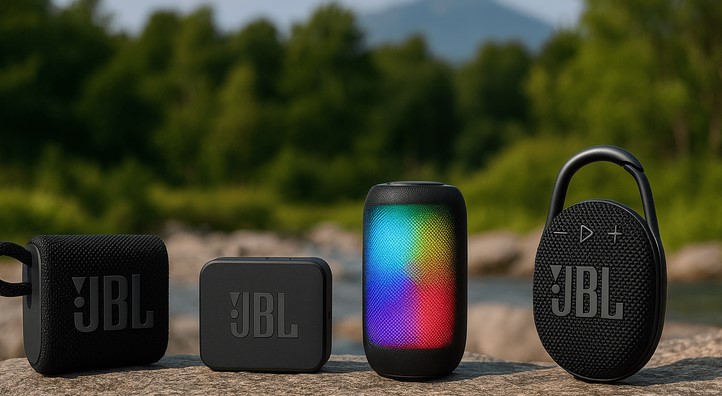
Imagine setting up a backyard barbecue or arriving at a beach campsite, hitting play on your favorite playlist, and being greeted by a tinny, distorted buzz that gets swallowed whole by the open air.
Over my past decade evaluating audio hardware and consumer tech, I’ve seen hundreds of people fall for the same trap: buying a compact speaker based on slick marketing photos, only to realize it sounds like a smartphone speaker playing inside a tin can.
Achieving massive, room-filling audio out of a device small enough to throw into a backpack used to violate the fundamental laws of acoustic engineering. But material science, digital signal processing (DSP), and battery tech have reshaped the landscape.
Today, modern portable bluetooth speakers deliver deep bass, crisp highs, and astounding volume levels without requiring a dedicated power outlet or a luggable boombox form factor.
The Acoustic Dilemma: How Small Speakers Produce “Big Sound”
Physics is stubborn. To create deep bass, you need to move a large volume of air, which traditionally requires large speaker cones and heavy enclosures. So how do modern ultra-portable devices trick our ears into hearing massive sound?
+-------------------------------------------------------------+
|               TRADITIONAL VS. MODERN PORTABLE AUDIO         |
+-------------------------------------------------------------+
| Traditional Audio  --> Large Enclosure + Heavy Subwoofer     |
| Modern Portables   --> Active Drivers + Passive Radiators   |
| Combined Ecosystem --> Real-Time DSP Audio Optimization     |
+-------------------------------------------------------------+
During teardowns in my hardware lab, the secret behind high-output portable bluetooth speakers comes down to three core innovations working in tandem:
1. Passive Radiators
Instead of adding a heavy secondary powered driver or an open bass-reflex port (which ruins waterproofing), engineers use passive radiators. These are unpowered diaphragms that react dynamically to the air pressure created inside the sealed cabinet by the active drivers, effectively doubling the low-end punch without burning extra battery life.
2. Advanced Digital Signal Processing (DSP)
DSP acts as the dynamic brain of the speaker. As you crank the volume up, DSP continuously adjusts equalizers in real time—boosting bass at low volumes so the music sounds full, and tapering off sub-bass at 90% volume to prevent muddy distortion and speaker blowout.
3. Neodymium Driver Magnets
Older speakers relied on bulky ferrite magnets. Modern portable speakers use neodymium magnets, which generate vastly stronger magnetic fields per ounce, allowing micro-drivers to push air with astonishing force without weighing down your bag.
Analogy: Think of an active driver like a person jumping on a trampoline, and the passive radiator like a second person standing on the edge. Every time the jumper lands, the trapped energy pushes the second person into the air automatically. You get twice the action without spending twice the energy.
Key Features to Look For in Portable Bluetooth Speakers
Navigating spec sheets can be confusing for beginner and intermediate buyers. When evaluating options, focus on these essential hardware metrics rather than raw wattage numbers.
Bluetooth Codecs and Versioning
In 2026, Bluetooth 5.3 and 5.4 are standard, providing rock-solid range and minimal latency. Look for codec support beyond standard SBC:
-
AAC: Excellent for iOS device owners.
-
LDAC / aptX Adaptive: Essential for Android users seeking high-bitrate, near-lossless audio streaming.
IP Ratings (Water and Dust Resistance)
If your speaker is leaving the living room, check the IP (Ingress Protection) code:
-
IPX7: Can survive complete submersion in 1 meter of water for up to 30 minutes.
-
IP67: Fully dustproof and waterproof—the gold standard for outdoor use, beach trips, and dusty trails.
Battery Capacity vs. Real-World Playtime
Manufacturers often calculate battery life at 50% volume with lighting effects turned off. If you plan to blast your portable bluetooth speakers at 80% volume during an outdoor party, expect actual playback times to drop by 30% to 50%.
Pro Tips & Hidden Pitfalls: An Audio Tech Veteran’s Advice
Having torture-tested dozens of audio products across various environments, here are the non-obvious factors that determine whether a speaker will exceed your expectations or disappoint you.
Pro Tips for Better Sound
-
Corner Boundary Loading: Want instant free bass? Place your portable speaker near a wall or, ideally, in the corner of a room. The physical surfaces act as an acoustic horn, bouncing low frequencies back toward you and boosting perceived bass by up to 3dB to 6dB without touching an EQ slider.
-
Pairing Dual Units: Many modern brands (like JBL, Soundcore, and Ultimate Ears) offer multi-speaker stereo pairing. Running two smaller units in true Wireless Stereo (TWS) mode provides significantly better soundstage separation and coverage than a single, larger speaker.
Hidden Pitfalls to Avoid
-
The “Peak Wattage” Trap: Ignore marketing claims touting “100W Peak Power!” Peak wattage represents a millisecond burst before the speaker blows up. Always look for RMS (Root Mean Square) wattage, which measures real continuous output power accurately.
-
Mono vs. Stereo Driver Configurations: Many compact cylinder speakers downmix audio into a single mono channel. While fine for casual listening, complex tracks with wide stereo panning can lose spatial separation entirely. Look for dual-driver designs if soundstage fidelity matters to you.
-
Heavy Bass at the Cost of Mids: Cheap manufacturers often over-tune passive radiators to create boomy, muddy bass, completely drowning out vocal clarity and acoustic instruments.
What’s Next: The Future of Portable Audio
Where is portable audio heading over the next few years? The integration of spatial audio algorithms and smart acoustic tuning is rapidly changing how small hardware performs.
+---------------------------------------------------------------+
|                 THE FUTURE OF PORTABLE AUDIO                  |
+---------------------------------------------------------------+
| Spatial Audio DSP   --> Virtual 3D Soundstage from 1 Device  |
| Auracast Bluetooth  --> Broadcast Audio to Unlimited Speakers |
| Smart Auto-EQ       --> Real-time Room Correction Tuning       |
+---------------------------------------------------------------+
Technologies like Bluetooth Auracast allow a single audio source to broadcast simultaneously to an unlimited number of nearby speakers, regardless of brand. Combined with self-calibrating internal microphones that tune sound to match room acoustics automatically, the gap between portable gear and home hifi setups is closing fast.
Final Thoughts
Finding high-performing portable bluetooth speakers isn’t about buying the biggest box on the shelf—it’s about understanding how smart engineering, proper placement, and clean audio processing work together to punch above their weight class. Whether you’re looking for an ultra-durable trail companion or a sleek poolside centerpiece, prioritizing driver quality and IP ratings ensures your investment lasts for years.
Over to You: What is your go-to outdoor playlist track to test out dynamic bass and vocal clarity? Are you prioritizing battery life or maximum volume for your next speaker upgrade? Drop your thoughts and favorite audio gear recommendations in the comments below!