
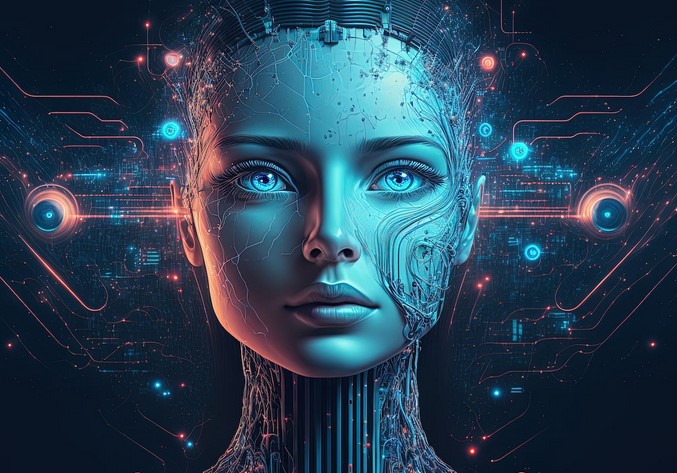
Artificial Intelligence (AI) has steadily been infiltrating various fields, with one of its most groundbreaking applications being in the realm of visual arts. AI image generators are revolutionizing the creative industry, offering artists, designers, marketers, and hobbyists a powerful tool to bring their ideas to life with the help of algorithms. These sophisticated systems use deep learning and neural networks to generate images from textual descriptions, making it possible for anyone to create visually stunning content without needing advanced graphic design skills. In this article, we will explore the functionality of AI image generators, their applications, and how they are reshaping the creative landscape.
1. How AI Image Generators Work
AI image generators work by leveraging deep learning models, often based on generative adversarial networks (GANs) or transformer-based architectures, to transform textual prompts into visual outputs. These systems have been trained on massive datasets of images and their associated descriptions, allowing them to learn patterns, styles, and associations between language and visual elements.
At the core of the technology lies the ability of these AI systems to understand natural language and translate it into pixel-based images. For instance, you can input a simple prompt like “a futuristic cityscape at sunset,” and the AI image generator will produce an image that visually matches the description. The process involves two main stages: the generator, which creates images from random noise or textual input, and the discriminator, which evaluates the realism and quality of the generated image. The two networks work together to improve the output, resulting in increasingly refined images over time.
2. Applications of AI Image Generators
a) Revolutionizing Art and Design
AI image generators have become a game-changer in the world of art and design. Artists, both professionals and amateurs, can now explore new creative avenues by generating original pieces of art in seconds. These tools democratize the creative process, giving individuals without formal training the ability to create compelling visual content. Whether it’s generating abstract art, realistic landscapes, or even digital portraits, AI image generators provide endless possibilities for creative expression.
For example, graphic designers can use AI image generators to quickly prototype designs or explore multiple variations of a concept before committing to a final version. This accelerates the creative process and reduces the time spent on manual iterations. Similarly, digital artists can experiment with new styles or themes, allowing them to push the boundaries of their work without spending hours on detailed drawing or painting.
b) Enhancing Marketing and Advertising
In the marketing and advertising industries, AI image generators have proven invaluable for producing high-quality visuals quickly and at a fraction of the cost of traditional methods. Marketers can generate customized visuals for social media posts, advertisements, website banners, and product designs by simply inputting specific prompts that align with their branding message.
These generators can create unique images tailored to particular audiences or demographics, enabling personalized and engaging content. Moreover, AI-generated images can be used in A/B testing to determine which visual assets resonate best with a target audience, optimizing campaign effectiveness. As a result, AI image generators are significantly reducing the reliance on stock images and expensive photoshoots, giving brands the ability to produce fresh, tailored visuals on-demand.
c) Facilitating Content Creation for Video Games and Animation
AI image generators are also being increasingly used in the gaming and animation industries. Designers can use these tools to create realistic textures, environments, characters, and backgrounds in a fraction of the time it would take through traditional manual methods. For instance, when developing expansive video game worlds or animated sequences, AI can generate detailed environments based on a simple textual description or a rough concept sketch, allowing creators to visualize complex scenes with ease.
Furthermore, AI image generators are also being employed to generate concept art for characters or creatures, significantly speeding up the initial stages of production. This not only streamlines workflows but also opens up new possibilities for independent game developers and animators, who might otherwise lack the resources to create high-quality visuals from scratch.
3. Benefits and Challenges of AI Image Generators
a) Benefits of AI Image Generators
- Enhanced Creativity: AI image generators serve as powerful tools for inspiration, helping users visualize concepts or creative ideas that they might not have been able to express otherwise. Whether it’s for artists, designers, or marketers, these tools expand the creative potential by offering fresh perspectives on ideas.
- Time and Cost Efficiency: Generating high-quality images manually can take a significant amount of time and resources, especially for complex designs or large-scale projects. AI image generators streamline the process, allowing users to create images in minutes, saving both time and money.
- Customization: Users can provide highly specific inputs, such as styles, color schemes, or thematic elements, to generate images that align with their exact needs. This flexibility ensures that the generated images are unique and tailored to the project at hand.
- Accessibility: AI image generators make high-quality design and art creation accessible to anyone, regardless of technical skill or experience. This democratization of creativity empowers individuals who may not have formal training in graphic design or art but still wish to create visually appealing content.
b) Challenges of AI Image Generators
- Ethical Concerns: As AI image generators become more capable, they raise concerns about originality and copyright infringement. AI-generated images often borrow from vast datasets that contain works created by human artists, leading to questions about ownership and fair use. There is ongoing debate about how to address these issues in terms of intellectual property laws and attribution.
- Quality Control: While AI image generators are improving in quality, they are not always perfect. Sometimes the images may lack realism, contain artifacts, or fail to meet the user’s expectations. Continuous refinement and feedback are necessary to improve the quality and accuracy of the generated images.
- Dependency on Data: AI systems are only as good as the data they are trained on. If the dataset used to train an image generator is biased or incomplete, the outputs may reflect those limitations. This can result in unintentional biases in generated images, particularly in contexts such as diversity representation or cultural sensitivity.
- Loss of Human Touch: Despite their capabilities, AI image generators lack the emotional depth, intuition, and personal touch that human artists bring to their work. While AI can produce technically impressive images, it may not fully capture the nuance, intention, or soul that a human creator can imbue into their work.
AI image generators are revolutionizing the world of creativity, offering a new way for individuals and professionals to produce visually striking content with the help of algorithms. By combining the power of deep learning with creative expression, these tools are reshaping industries such as art, design, marketing, gaming, and more. However, like any emerging technology, AI image generators also bring forth challenges, including ethical concerns and issues of quality control. As these tools continue to evolve, they will undoubtedly play a central role in the creative process, enhancing human imagination and productivity. As we look to the future, it is clear that AI image generators will continue to fuel creativity, offering limitless possibilities for artistic and professional growth.